Mathematics
Program Highlights
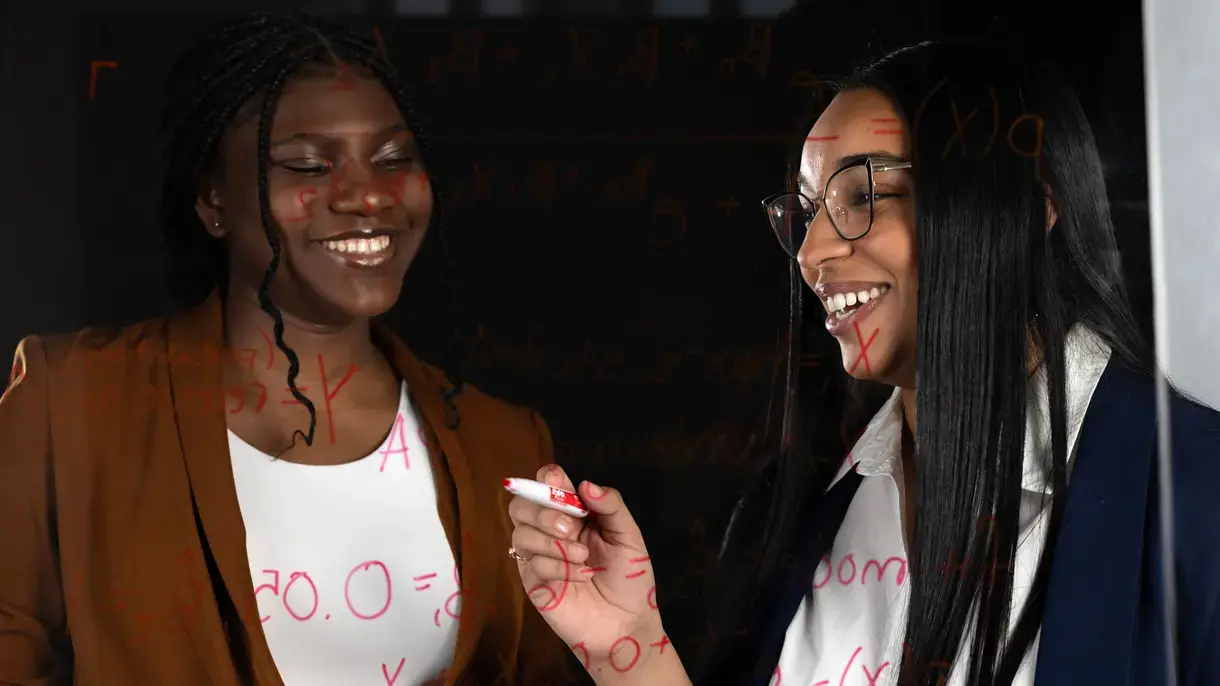
Those who study Mathematics develop critical thinking and problem-solving skills through the study of abstract concepts, theories and applications. The field is constantly evolving, incorporating new theories and methodologies that reflect advancements in technology and shifts in societal needs, which encourages people to address challenges both systematically and creatively. It serves as the language of the sciences and social sciences, providing the tools to model natural phenomena, analyze data and solve complex problems.
Areas of Study
All majors are educated in central areas of mathematics including calculus, multi-variable calculus, mathematical structures, linear algebra, real analysis and modern algebra. Majors then choose a path through upper-level courses based on their interest, choosing courses from these areas:
- Analysis
- Algebra
- Geometry and Topology
- Applied Mathematics
- Statistics
Major Requirements
Mathematics majors are required to complete 11 courses, including:
- MATH 135
- MATH 136
- MATH 241
- MATH 243 (or MATH 123)
- MATH 244
- MATH 351
- MATH 361
- Four electives
In addition to the required courses, majors must take at least four elective courses, at least three of which must be mathematics courses numbered above 300, STAT 375 (Probability Theory) or STAT 376 (Mathematical Statistics). Majors may also take CSCI 131, STAT 231 or STAT 232 as one of their electives. At least one elective must be a project course.
In these courses, in place of a final exam, students work on a substantial project leading to a written report and an oral presentation.
These projects provide majors with independent learning experiences, where students either investigate some topic using the tools and concepts studied in the course or explore mathematical topics beyond those covered in the course.
Majors are encouraged to take advantage of the close student-faculty contact afforded by upper-division seminars, independent study and departmental honors, which permit students to explore topics of mutual interest to students and faculty that are not part of the regular course offerings. Also, throughout the curriculum of independent work and courses, students are able to explore and utilize the growing relationship between mathematics and computing.
Students who have received a score of 4 or 5 on the AP Calculus AB exam, or a subscore of 4 or 5 on the AP Calculus BC Exam, will earn credit for MATH 135 and are advised to take MATH 136. Students will forfeit their credit if they opt to take MATH 133 or 135.
Students who receive a score of 4 or 5 on the AP Calculus BC exam will earn credit for MATH 136 and are advised to take MATH 241 (Multivariable Calculus). Students will forfeit their credit if they opt to take MATH 133, 135 or 136.
Minor Requirements
Minors must take a minimum of 7 courses offered by the mathematics and computer science department. The following courses are required:
| MATH 135 | Calculus 1 |
| or MATH 133 | Calculus 1 with Fundamentals |
| MATH 136 | Calculus 2 |
| MATH 243 | Mathematical Structures |
| or MATH 123 | Discrete Mathematics |
| MATH 244 | Linear Algebra |
Minors must also choose one of the following courses:
| MATH 351 | Modern Algebra 1 |
| MATH 361 | Real Analysis 1 |
Students must also select two of the following elective courses, with at least one at the 300-level:
| MATH 241 | Multivariable Calculus |
| MATH 301 | Topics In Geometry |
| MATH 302 | Differential Geometry |
| MATH 303 | Mathematical Models |
| MATH 304 | Ordinary Differential Equations |
| MATH 305 | Complex Analysis |
| MATH 351 | Modern Algebra 1 2 |
| MATH 352 | Modern Algebra 2 |
| MATH 353 | Number Theory |
| MATH 357 | Combinatorics |
| MATH 361 | Real Analysis 1 2 |
| MATH 362 | Real Analysis 2 |
| MATH 363 | Topics In Topology |
| MATH 371 | Methods of Numerical Analysis |
| MATH 373 | Partial Differential Equations |
| MATH 374 | Dynamical Systems |
| MATH 392 | Seminar |
| STAT 375 | Probability Theory |
Department Chair


Opportunities

Research
Research with faculty, both during the academic year and over the summer as part of Weiss Summer Science Research program.

Clubs & Organizations
Math and Computer Science Club sponsors student-centered events throughout the year, including a weekly tea and games. The Math and Computer Science Mentorship program pairs first-year students with junior and senior majors. The Student Chapter of the Association for Women in Mathematics (AWM) organizes social events and professional development opportunities that align with AWM’s goal to promote equitable opportunity and gender-inclusivity across the mathematical sciences.

Awards
The Gertrude McBrien Prize in Mathematics is awarded to the outstanding mathematics major (or majors) in each graduating class. The selection is based on whether students have chosen challenging course programs, the grades they have earned in their mathematics courses, and also takes into account any research projects they may have worked on and their plans after graduation.
Graduate Opportunities
3-2 Engineering Program
The 3-2 Engineering Program with Columbia University or the Collaborative Accelerated Master’s Program with Worcester Polytechnic Institute provide the opportunity to combine the study of mathematics with training in engineering. Both engineering programs are open to students of all majors and class years.

Entrepreneurship, Technology and Innovation Graduate Opportunity
This graduate opportunity allows Holy Cross students a preferred admissions opportunity into Notre Dame’s ESTEEM Graduate Program in Entrepreneurship, Technology and Innovation.
Outcomes
Mathematics students are provided with an opportunity to:
- Develop modeling skills, translate questions into a suitable mathematical, statistical and/or computational format and evaluate the model.
- Read and understand symbolic notation, mathematical formulas and/or specifications of algorithms and express their thoughts using these formalisms.
- Apply deductive reasoning to analyze the consequences of conditions and assumptions.
- Apply inductive reasoning to draw conclusions from results of mathematical, computational or statistical investigations.
- Formulate solutions to quantitative problems using numerical, geometric/graphical and algebraic methods.
- Design, implement, document and evaluate solutions using computational methods.
- Create data visualizations and apply statistical methods consistent with the study design.