Catholics & Cultures

Catholics & Cultures is a field-leading initiative of the McFarland Center that draws scholarly attention to the ways that ordinary Catholics practice their faith in their everyday lives in a huge array of cultural contexts. The initiative sponsors the Catholics & Cultures website, scholarly conversations, international conferences and an open access, peer reviewed academic journal, the Journal of Global Catholicism.  

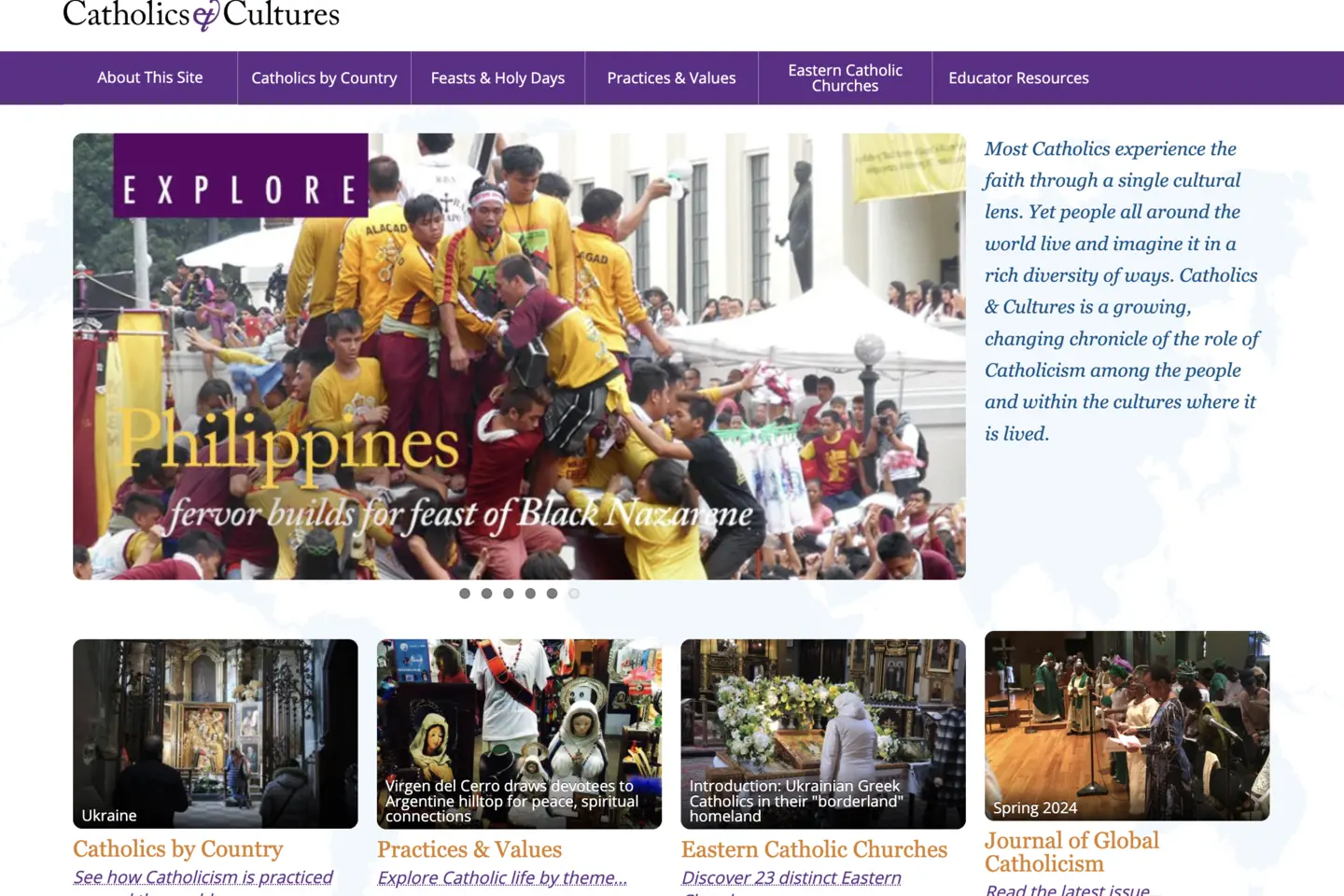
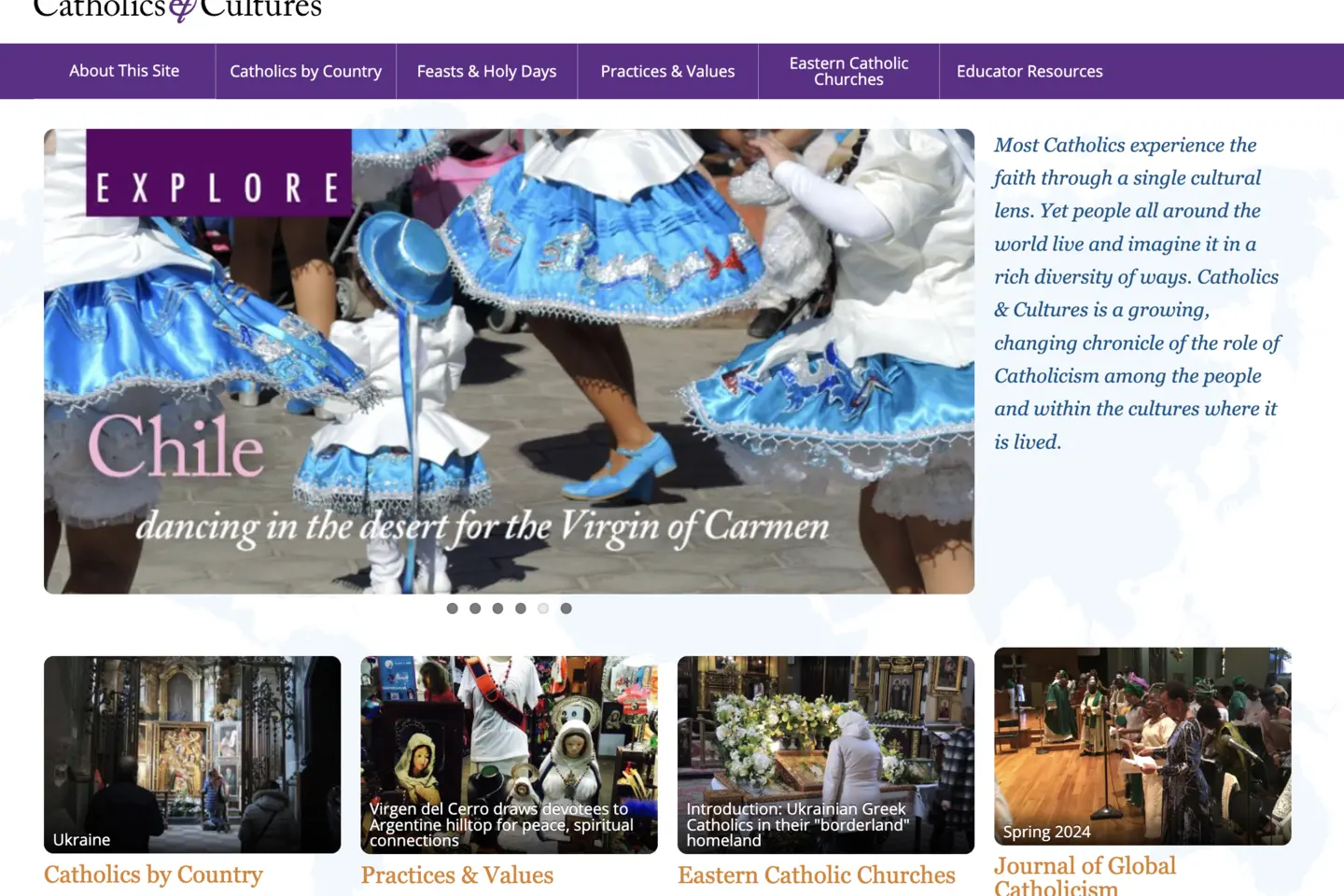
A screenshot of the Catholics & Cultures website.

The Catholics & Cultures website has published more than 250 articles on 33 countries across five continents. These, plus accompanying demographic data and videos, provide insight into particular cultures and local variations on Catholic practice.  The site's articles and videos have been accessed more than 10 million times by users in 206 countries since the site's launch in 2015.

The Catholic World

nuns on donkeys

The Catholic World, an upcoming volume set to be published in the Routledge Worlds Series, aims to be a comprehensive resource for scholars and students who wish to engage with Catholicism not as a monolith, but as an ever-evolving and locally instantiated lived religious tradition. It features writing with perspectives spanning not only North America, but across the globe.


Read the abstract and find the chapter outline for the upcoming volume here.

Journal of Global Catholicism

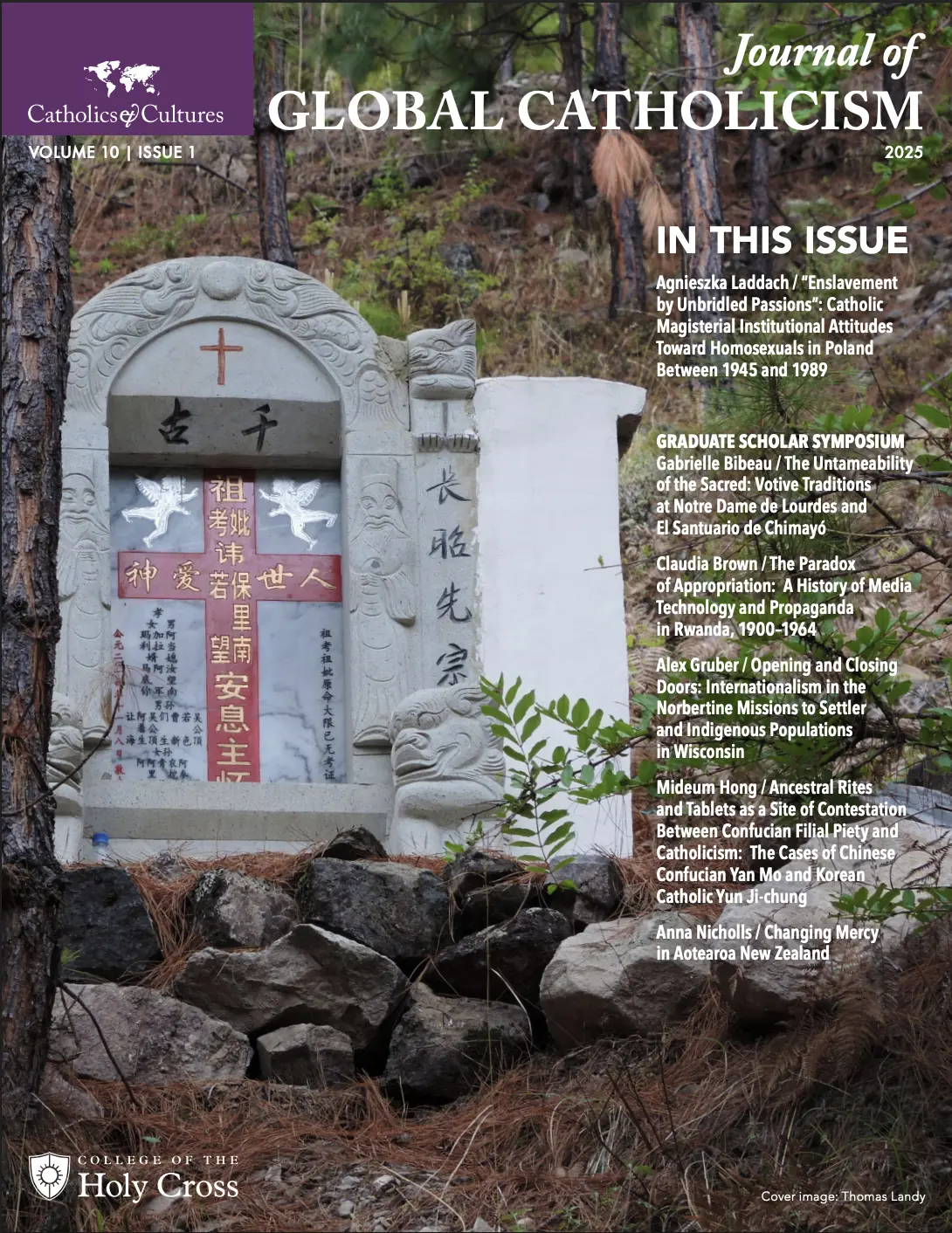
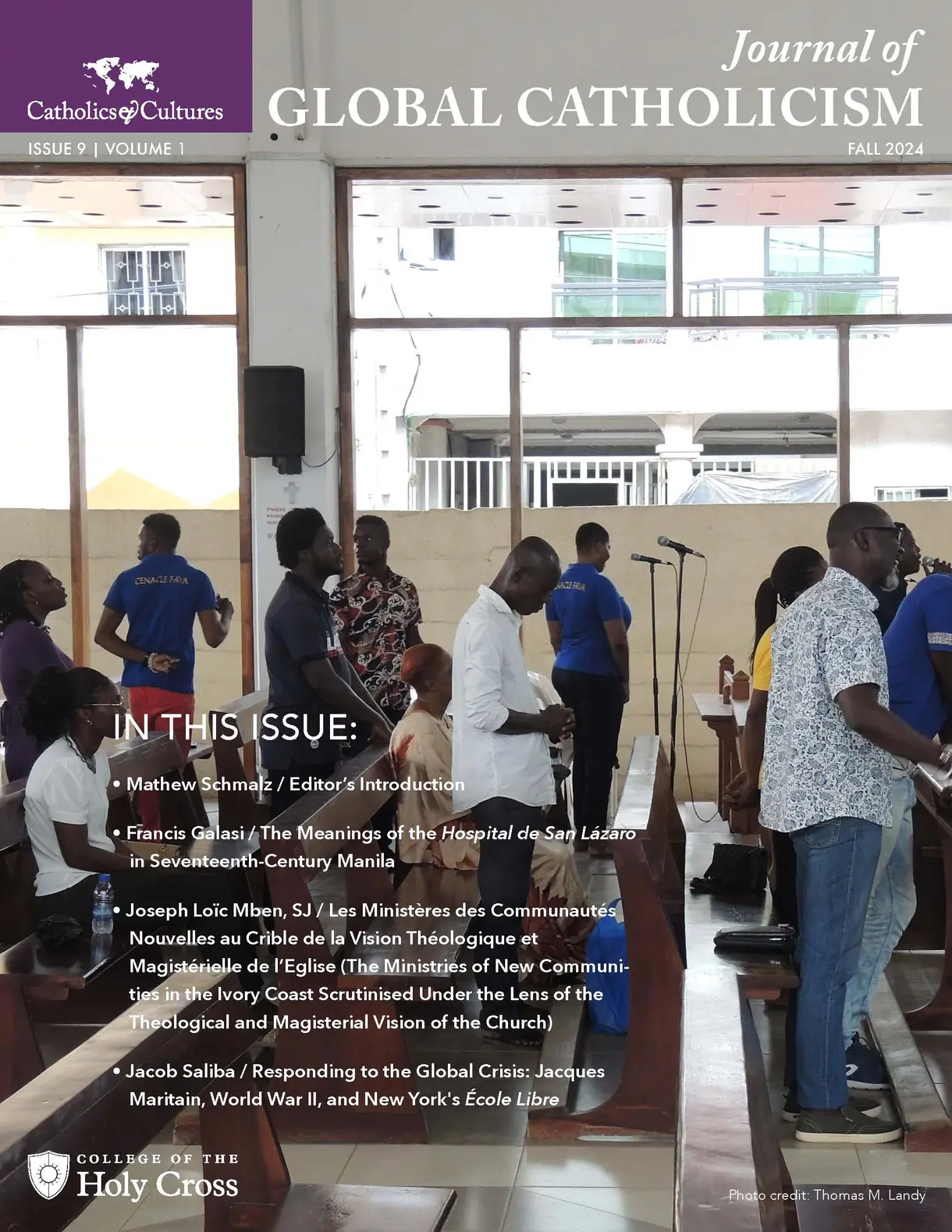
The cover of the 2025 issue of the Journal of Global Catholicism


Since its launch in 2016, the Journal of Global Catholicism, an open-access, peer-reviewed scholarly journal, has emerged as the leading journal in this rapidly emerging field. 

Journal of Global Catholicism cover


In addition to scholarly articles, most JGC issues also include discussions with scholars and other prominent individuals in the field of Global Catholicism. You can view all of the interviews on our YouTube channel

The cover of the Journal of Global Catholicism

Current Issue

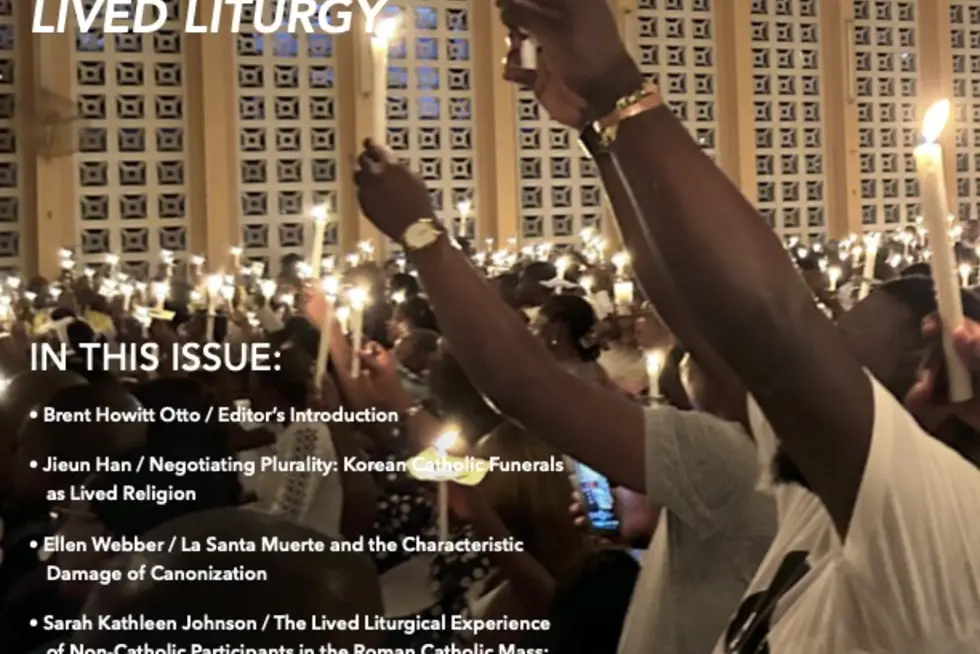
The latest issue of the Journal of Global Catholicism explores the topic of Lived Liturgy. Liturgy occupies a distinct and central place in Catholic life. One of the Second Vatican Council’s seminal documents, the Sacred Constitution of the Liturgy, Sacrosanctum Concilium, famously declared that the Liturgy is both “the summit toward which the activity of the Church is directed; at the same time it is the font from which all her power flows.” Yet liturgy is never only the prescribed prayers and rituals, nor the theology underpinning them. It is enacted by particular people, in places and times, from their own unique cultures, politics, and social conditions. To attend to lived liturgy is, therefore, to ask what happens when the Church’s ritual forms are inhabited.

Read The Journal

The Journal's Reach

The Journal is featured in major academic indexes like SCOPUS. Accomplishments over its 10 years include:

  • 117 Published articles
  • 180 Countries represented in the Journal's readership
  • 82,742 Articles downloaded

Global Catholicism Grants

To strengthen the College's teaching and research on global Catholicism, the McFarland Center provides supplemental research funding through a competitive grant program open to all Holy Cross faculty.


The Fall 2026 Global Catholicism Grant recipients are:


The Liturgical Movement from a Global Perspective


Fall 2026


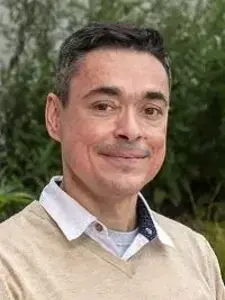
Grant Recipient: Audrey Seah


This project challenges the conventional Eurocentric history of the modern Catholic Liturgical Movement by demonstrating its global, bidirectional origins. While the movement is traditionally traced to nineteenth- and twentieth-century European monastic centers, this research argues that reforms later codified by the Second Vatican Council—including vernacular liturgy, indigenous clergy, and the integration of local cultural traditions—were anticipated in mission communities in East Asia and the Catholic Kingdom of Kongo as early as the fifteenth and sixteenth centuries. Drawing on archival research and previously understudied liturgical sources, the project repositions non-European Catholics as active contributors to modern liturgical reform and reframes the movement as the product of centuries of global exchange rather than the one-way diffusion of European ideas.


Northern (In)visibility: Retrieving Black Catholic Stories 


Fall 2026


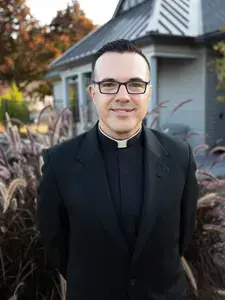
Grant Recipient: Chanelle Robinson


This project investigates the overlooked history of Black Catholicism in Canada, challenging narratives that position Black Catholic experience primarily within the United States while obscuring Canada's own histories of slavery, migration, and racial segregation. Beginning with the life of the enslaved Black Catholic woman Marie-Joseph Angélique and extending to the development of Black Catholic communities in twentieth-century Ontario, the project draws on archival research to examine how Black Catholics shaped ecclesial life, negotiated belonging, and responded to changing cultural and religious landscapes. By centering Canadian experiences, this research expands the field of Global Catholicism and offers a more historically and geographically inclusive understanding of Black Catholic life in North America.  

2026 Faculty Grants

J.R.R. Tolkien: A Life in Ten Letters


Fall 2026


Grant Recipient: Jonathan Mulrooney


This project develops a new biography of J.R.R. Tolkien through ten significant letters spanning his life, from childhood through the final days before his death in 1973. Moving beyond the conventional image of Tolkien as a secluded Oxford academic, the project examines the intellectual, cultural, and spiritual experiences that shaped his writing and its extraordinary reception. The selected letters illuminate Tolkien’s relationships with family, fellow writers, scholars, and readers, as well as the linguistic, literary, and religious foundations of his work. By organizing the biography around these letters rather than a strictly chronological narrative, the project offers a new approach to understanding the complex relationship between Tolkien’s life and the imaginative world he created. Archival research at Oxford University, Marquette University, and Wheaton College will draw on Tolkien’s papers and those of his wider literary circle, the Inklings, to situate his work within the intellectual and religious currents of the twentieth century.


Save China, Save Peace: Transnational Activism and Internationalism in the Global World War II


Fall 2026


Grant Recipient: Ke Ren


This book project examines Chinese engagement with transnational peace movements and international organizations from the 1930s through the early Cold War, placing China at the center of a global history of World War II-era internationalism. Focusing on networks ranging from antifascist campaigns and grassroots peace organizations to anti-imperialist movements, the project explores how Chinese activists and their international counterparts connected resistance to imperialism and fascist aggression with broader efforts to secure world peace. It also considers the role of religious organizations and communities, including the Fellowship of Reconciliation and Chinese Buddhist and Muslim movements, in developing diverse approaches to pacifism, peacebuilding, and transnational justice during a period of global conflict. Archival research at the International Institute of Social History in Amsterdam will provide materials from major international peace organizations and movements, contributing to a monograph that brings Chinese participants into a history of twentieth-century internationalism from which they have often been absent.


More than a Human Mirror: Animals, Confucian Ethics and Buddhist Reinterpretation of Xu Qian’s Even Animals Are Thus


Fall 2026


Grant Recipient: Ji Hao


This project examines the role of animals as moral and religious agents in Chinese ethical thought through Xu Qian’s (1776–1864) Even Animals Are Thus (Wuyou ruci). Rather than treating its animal stories as entertainment or simple allegories for human behavior, the project explores how Xu used narratives of animal loyalty, suffering, and retribution to address moral causality, human responsibility, and compassion at the intersection of Confucian ethics and Buddhist thought. It also traces the text’s reinterpretation by Buddhist writers and artists during the Republican era, when new editions and adaptations connected its animal narratives to Buddhist teachings on compassion, karmic causality, non-killing, and the protection of life. Research at the National Library of China will include consultation of the earliest woodblock-printed edition of Even Animals Are Thus, supplemented by archival and library research elsewhere in China and fieldwork in Jiangxi and Hangzhou related to Xu Qian and artist Feng Zikai. By tracing the text from its late-imperial origins through its twentieth-century Buddhist reinterpretation, the project demonstrates how animals became an important site for negotiating religious belief, ethical responsibility, and moral self-cultivation in modern Chinese intellectual history.
Past Recipients

Spring and Summer 2025

Grant Recipients: Matthew Eggemeier and Peter Fritz, Religious Studies

This new co-authored book project, provisionally titled Theologizing the Just Peace Movement: Catholicism, War, and Peacebuilding, will offer a Catholic systematic theology of just peace, developed out of Catholic practices of nonviolence and resistance to American militarism abroad and racialized state violence domestically. The "Just Peace" framework we will explore accounts for a variety of social practices geared toward resolving social conflicts without recourse to violence except in extreme cases of last resort. This book will use systematic theology to help understand and practice Just Peace by discovering coherent yet implicit theologies of peace in the work of global Catholic organizations dedicated to fostering justice as a way toward building lasting peace. 

Spring 2026

Grant Recipient: Audrey Seah, Religious Studies

In a Singapore state-run columbarium where people of different religions are put to rest, it is common to find dollhouse-sized polymer clay miniatures of local foods attached to the niche plaque or the base of a columbarium niche of Catholics with Chinese ancestry. Using Chinese ancestral rites as a starting points and drawing upon the concept of diffused religion, this project aims to investigate the prevalence of these polymer clay miniatures and associated spiritualities of death and the afterlife by observing practices at Catholic cemeteries and columbariums over the Lunar New Year season. In line with the goals of the McFarland Center Global Catholicism grant, potential findings may challenge the binary of liturgy and popular religiosity and diffused religion and institutional Catholicism, and facilitate the identification of expressions of indigenized Catholicism in the Sinosphere.