
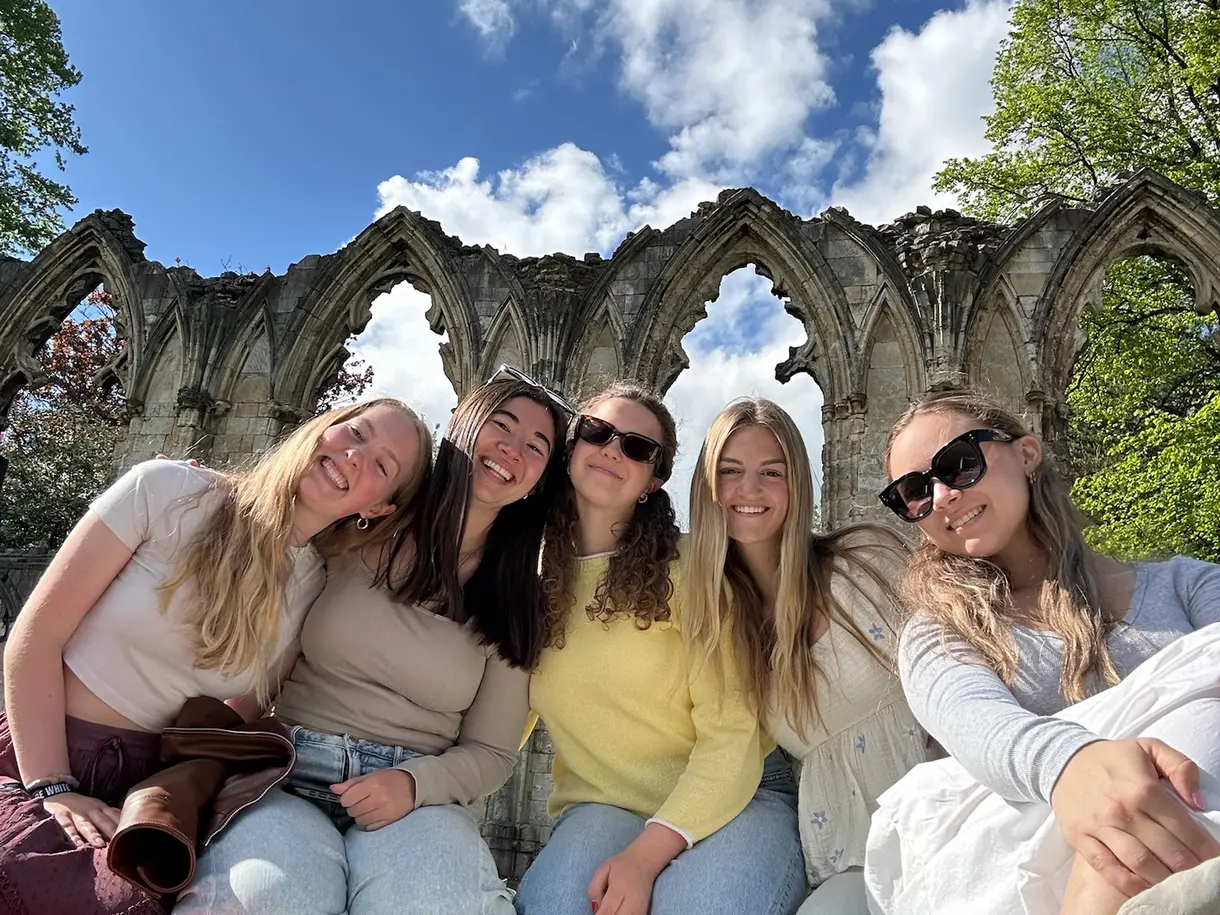
Study Abroad

Immerse yourself in a life-changing experience.
Explore our portfolio of high impact, academically rigorous study abroad programs.
Experiential Learning at Home and Abroad
Holy Cross supports a vibrant and diverse community of students in our study abroad programs — from those specializing in STEM fields to others balancing multiple majors, minors and concentrations. No matter your academic path, our goal is to make you feel empowered to explore the world and make the most of your college experience.
Our team of experienced advisors is committed to supporting you every step of the way, offering personalized guidance that reflects your unique academic interests and future plans. We will work closely with you to help ensure that your study abroad experience aligns with your coursework, personal goals and career aspirations.
Study Abroad at a Glance
- #1 In the nation amongst baccalaureate institutions for yearlong study abroad according to the Institute for International Education
- 70+ Study abroad programs across the world View Programs
- 100+ Students participate in the Maymester program each summer
- 40% Of Holy Cross students go abroad each year, mostly in their junior year
- 33% Of study abroad students are STEM majors


Programs
Maymesters
Lasting approximately 4 weeks and typically beginning in mid to late May, Maymesters are academically rigorous, short-term study abroad programs led by Holy Cross faculty. They offer students an immersive learning experience during which they travel, study and explore in close collaboration with professors and classmates. Students earn one Holy Cross credit as they engage with new cultures and diverse perspectives.
Maymester programs change each year and are offered on a rotating basis. The lineup is announced in early fall and students have until Nov. 1 to apply for all Maymester programs running the following summer.
Semester & Yearlong Programs
Studying abroad for a semester or year is an incredible way to step out of your comfort zone, experience new cultures, and gain a global perspective that goes far beyond Worcester. You’ll build lifelong friendships, develop valuable skills, and discover more about yourself.
Applications are open now, and the deadline to apply is Nov. 30.
Funding Study Abroad
There is no additional fee to study abroad for a semester or an academic year.
The College of the Holy Cross operates on the 'Home School Tuition Model', which means that a semester abroad costs the same as (and sometimes a little less than) a semester at Holy Cross. Financial aid 'travels', and student financial aid packages are not impacted by study abroad.
Maymester program costs vary depending on the specific program, typically ranging from $6,000-$8,500. To help make these programs accessible, Holy Cross has made opportunity funds available to support eligible students participating in Maymesters.
Out-of-pocket expenses such as airfare, meals, passport/visa expenses and personal expenses are typically not included in the program price and may vary depending on the specific program.
Please note that this list is not exhaustive - actual expenses will differ by program.

Steps to Study Abroad
All students who plan to study abroad during their Junior Year apply during the fall of their Sophomore year.

Study Abroad Expo
Happening in early September.

Study Abroad “General” Information Session
Happening in mid-September.


Drop-In Advising
Fall: Wednesdays and Thursdays, 2-4 p.m., Smith Hall; and Spring: Thursdays, 2-4 p.m., Smith Hall rooms 331-334



Decisions
Decisions are made by Feb. 1. Students will be notified via HC email when their application status changes.


International Health and Security Insurance Coverage
Student health and safety is a top priority for the Office of Study Abroad. All Holy Cross students participating in semester, academic year, or Maymester study abroad programs are automatically enrolled in International SOS (ISOS), a best-in-class global health, safety and emergency assistance provider.


Our Team
Have a question? Drop-in advising hours are Tuesdays, Wednesdays and Thursdays from 2-4 p.m.
- M.A., University of California Davis ; M.A., Brigham Young University
- Smith Hall, Office 334A
- jsummerhays@holycross.edu
- 508-793-3057/3082
- Oversees: Japan, China, Taiwan, Sri Lanka, Latvia
Emma Meade, Assistant Director
- M.A., University of Galway
- Smith Hall, Office 331
- emeade@holycross.edu
- 443-468-8953
- Oversees: Spain, Argentina, Mexico, Ecuador, Puerto Rico, Ireland, South Africa, Jordan, School for Field Studies Programs
Tammi Valeri, Study Abroad Manager (Study Away & Short-term Programs) and Finance & Billing Coordinator
- BA, Worcester State University
- Smith Hall, Room 334
- tvaleri@holycross.edu
- 508-320-1591
- Oversees: All Maymester Programs, Gallaudet University (Washington, DC), Morehouse College (Atlanta, GA), Spelman College (Atlanta, GA), Sea Education Association Program (SEA) (Woods Hole, MA)
FAQs for Families
Hello and Welcome
At Holy Cross, study abroad is a vital part of a liberal arts education -- an opportunity to learn through academic study, daily life, and meaningful engagement with a new community.
That learning begins in the classroom. Study abroad is first and foremost an academic endeavor. Students encounter new intellectual traditions, study subjects in context, and deepen their curiosity through courses, research, internships, and fieldwork. They learn to question assumptions, solve unfamiliar problems, and see their education and themselves from new perspectives.
The learning continues in everyday life. As students navigate new routines, relationships, and ways of communicating, they build independence, adaptability, and confidence. They learn to connect across differences and take initiative when the familiar falls away, skills that serve them in college, the workplace, and adult life.
Over time, study abroad can become a lifelong reference point, shaping future choices, career paths, relationships, and engagement with the wider world. The experience stays with students because it changes how they see and participate in that world.
Families are important partners in this journey. Your encouragement helps students prepare and thrive, while students take the lead in making decisions, communicating with College and program staff, and advocating for their needs. The Office of Study Abroad and our partners provide guidance as students meet challenges, discover new possibilities, and make this experience their own.
We look forward to helping your student learn openly, grow deeply, and carry the world forward with them.
General FAQs
Study abroad is a hallmark of high-impact learning. It offers students an unparalleled context for integrating the academic knowledge they are gaining at Holy Cross with personal growth and reflection, cultural competency, and lived experience, true to the College’s Jesuit mission.
The Office of Study Abroad offers over 70 approved programs located across the globe. Students can apply to study on semester, academic-year, and/or Maymester programs (4-6 week long faculty-led programs beginning in mid-May, after final exams).
Most students choose to study abroad during their junior year. However, students are eligible to study abroad during the second semester of their sophomore year (with deliberate planning), and the first semester of their senior year. All first-year students, sophomores, and juniors are eligible to apply for participation in a Maymester program. Students may study abroad on both a Maymester program and a program offered during the Fall/Spring terms as long as there is no conflict in acquiring a student visa.
The Office of Study Abroad engages in one application cycle for all students, regardless of their class year, preferred program, or desired length of term. Study Abroad opens its application portal on September 15. Students’ applications are due November 30. Approval notifications are sent February 1. Students must commit by February 15.
Study abroad is a student-driven endeavor. Therefore, families can best support their student by encouraging them to be informed, independent, and on time.
Due to FERPA regulations, the Office of Study Abroad can only discuss limited information with parents and guardians. Although Study Abroad does not send information directly to families, it makes information available for families via its Study Abroad Guide.
If a student’s parents or guardians contact the Office of Study Abroad, we will not discuss study abroad decisions directly with them. All correspondence related to study abroad should come directly from students. The Office of Study Abroad expects students to take ownership of the abroad experience and advocate for themselves.
The Office of Study Abroad carefully curates the programs in its portfolio so that students experience similar levels of academic rigor and support of all kinds while abroad. However, universities and programs abroad may differ significantly from the student experience at Holy Cross. Differences can also extend to facilities (access to a gym), commute times to classes, meal arrangements, etc. Therefore, it is essential for both students and families to set their expectations accordingly and to remain flexible, open-minded, and resilient.
Students who receive an accommodation(s) at Holy Cross should inform the Office of Study Abroad prior to applying to that program to discuss whether that specific host institution/program is able to offer the kind of accommodation needed for the student to thrive. The Office of Study Abroad will help advise students appropriately.
Provided that an accommodation is possible, students and their families should expect that the student will receive an accommodation similar to the one they receive at Holy Cross. An exact accommodation cannot be guaranteed.
Academic FAQs
Holy Cross students participating in semester or academic year study abroad are required to maintain a minimum 3.0 GPA prior to their date of departure. If a student has a credit deficiency on their Holy Cross transcript (i.e., due to having failed a class, withdrawn from a class, or having sustained any other form of underenrollment), the student must address that deficiency prior to departure for study abroad. There are no exceptions to the deficiency policy.
Students participating in a Maymester program are not held to the deficiency policy. In contrast, the one course credit a student earns by successfully completing this form of study abroad programming will work to address a deficiency should one exist.
Study abroad is highly sought after at Holy Cross, and the number of interested students keeps growing. The Office of Study Abroad keeps pace with this interest by regularly evaluating new programs and introducing those of highest quality that will enrich student experience.
Students and their families should note that the goal of the Office of Study Abroad, in alignment with the College’s Jesuit mission, is not to recreate an identifiable community of Holy Cross students at an international destination, nor to impose a sizable one. Instead, we strive to offer students the rich growth opportunity of living and studying in an environment markedly different from their classroom and extracurricular life in Worcester.
Accordingly, and to achieve a more proportional balance between Fall and Spring semester enrollment abroad, number caps are placed on all Holy Cross study abroad programs. Caps vary by program and are clearly communicated to students.
To accommodate student preference, the Office of Study Abroad requires students to apply to one program and preferred term, and also to designate three alternate choices that represent real options for the student if they are not approved for their preferred program and term. Students can choose whether or not to commit to the program and term for which they are approved; however, they are not guaranteed their first choice.
The Office of Study Abroad will not discuss study abroad approval decisions directly with a student’s parents or guardians. All correspondence related to study abroad should come directly from the student.
Yes, a student will earn the necessary academic credit if they pass each of the HC-approved courses they take at their host institution. All Holy Cross students must take the equivalent of a full course load at their host institution - no exceptions. Therefore, by passing all approved courses for which they register, students will receive the necessary academic credit abroad that will help them maintain degree progress.
Students have access to a number of advisors who can support them in academic planning. These include their Holy Cross academic and/or departmental advisor(s), Office of Study Abroad staff, host institution mobility staff, and the designated academic advisor at their study abroad program provider.
Financial FAQs
There is no added fee for studying abroad. However, students will have additional out-of-pocket expenses such as airfare, passport and visa fees, refundable and security deposits and personal expenses. Students should also keep in mind that amenities available to students at HC may not be available or included at their specific study abroa location. Because each program has different components and features, students may have to pay out of pocket for laundry fees, printing, gym memberships, and local transportation. This list is not comprehensive, and students should carefully review the details of their specific program to plan for additional expenses.
Holy Cross operates under the Home School Tuition policy (HST), which means that students are charged Holy Cross tuition and housing fees, even though they are not attending classes at Holy Cross and residing on campus.
Meal plan (“board”) fees vary by study abroad program, depending on the number of provided meals, if any. For programs offering housing that is “self-catering” - i.e., students shop for themselves and prepare their meals in a shared kitchen - no meal plan fee will be charged.
In addition, students studying abroad will be charged approximately $235/semester for international health and emergency service coverage provided by International SOS. (See Health and Safety for more details.) This fee for ISOS coverage is heavily subsidized by the College.
The reason the student is billed directly by Holy Cross for the College’s tuition and housing is because they remain enrolled at Holy Cross, ensuring academic continuity and retaining access to important on-campus resources including College advising, academic oversight, transcript and degree-planning processes, Class Dean and Chaplaincy support, health and safety support, emergency assistance, and other services associated with an approved study abroad experience. This is the primary benefit of the Home School Tuition (HST) model.
HST also helps ensure that approved coursework taken abroad contributes appropriately to the student’s Holy Cross degree, and that participation does not unnecessarily disrupt progress toward the College’s eight-semester residential requirement or timely graduation.
Yes. The Home School Tuition policy permits eligible federal and institutional financial aid to be applied to a student’s Holy Cross account (subject to the requirements and limitations of the applicable aid programs). Therefore, financial aid “travels” and can be applied towards the student’s Holy Cross term bill during the Fall/Spring terms that a student studies abroad.
Students may be eligible to receive a flight credit based on the student's demonstrated financial need, as calculated by FAFSA and determined by the Financial Aid Office.
Since Maymester programs occur outside of the traditional academic cycle, financial aid does not apply to this form of abroad programming. Instead, students on aid who are approved to participate in a Maymester program will automatically be considered for aid in proportion to the financial support they receive during the academic year, but aid is not guaranteed and is contingent upon available funds.
Health and Safety
Yes, it is safe to study abroad. However, students and families must recognize and be willing to accept the inherent risks involved with international travel. For its part, the Office of Study Abroad commits to maximizing student safety as follows:
Holy Cross Study Abroad manages all its international partnerships with student safety and wellbeing as its topmost priority. Accordingly, the stability of each study abroad location is of paramount concern. The Office of Study Abroad receives daily global updates from International SOS (ISOS), the College’s contracted global provider for international health insurance and emergency services, including evacuation and repatriation. It therefore monitors security and risk throughout each study abroad term on a daily basis and in every location. Study Abroad also collaborates regularly with Risk & Compliance at Holy Cross, prepared with threat assessment and action plans that include risk thresholds.
A student’s individual behavior will certainly impact their personal safety as well. Therefore, it is essential that each student take responsibility for decisions and actions that will affect their safety and wellbeing as they reside, study, and travel abroad.
Holy Cross students participating in semester, academic year, and/or Maymester study abroad programs receive comprehensive health coverage while abroad from International SOS (ISOS), a prestigious global health, safety, and emergency assistance provider. ISOS coverage is mandatory for every Holy Cross student and entails a fee of approximately $235/semester. This fee will appear as a separate line item on the student’s Holy Cross term bill and is heavily subsidized by the College.
In addition to ISOS-mandated health coverage, all Holy Cross students participating in semester, academic year, and/or Maymester study abroad programs are required to maintain domestic health insurance for the period of time they study abroad. This may be defined as U.S.-based insurance and/or insurance based in the student’s country of residence.
Note: ISOS coverage is valid from the start date through the end date of the study abroad term. ISOS coverage does not apply to a student’s personal travel plans before or after their study abroad term dates.
For the duration of their designated program, Holy Cross students retain 24/7 access to ISOS professionals who are trained to provide comprehensive site-specific and student-specific health guidance in real time. This comprehensive support covers routine and emergency care for all physical and mental health needs.
Students may contact and, in fact, are highly encouraged to contact ISOS well before their departure date in order to prepare the details for continuous care while they study abroad.
Announcement: Update to Study Abroad Flight Credit Practice
Effective Fall 2027, we will adjust our study abroad flight credit policy to award flight credit on the basis of demonstrated financial need.
Holy Cross remains deeply committed to providing transformative study abroad opportunities. Effective Fall 2027, we will adjust our study abroad flight credit policy to award flight credit on the basis of demonstrated financial need. This practice aligns with peer institutions and helps us target financial support where it is needed most.
We recognize that travel costs are a meaningful consideration for students and families. Holy Cross will continue to support study abroad participation through individual advising and informed financial aid practices.
Additional details regarding need-based flight credits for eligible students will be forthcoming this fall.