



English
Areas of Study
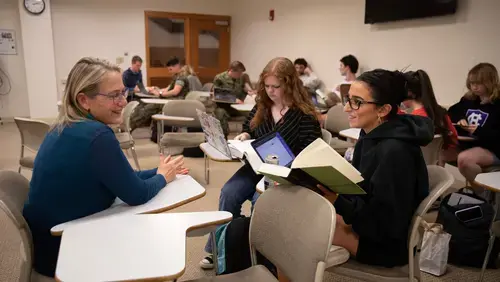
Each semester the department offers approximately 20 upper-division courses for majors, as well as numerous offerings for non-majors at the introductory and intermediate levels. These include:
- Courses organized by literary theme, genre, author and historical period
- Courses in poetics, literary theory and critical theory
- Creative writing courses
- Academic and digital writing courses
- Interdisciplinary courses cross-listed with Africana Studies; Catholic Studies; Gender, Sexuality and Women's Studies; Critical Race and Ethnic Studies; Environmental Studies; and Peace and Conflict Studies
Requirements
All English majors take Poetry and Poetics, an introductory course, which should be completed by the end of sophomore year.
Majors also take two intermediate courses, usually during the sophomore year:
- Touchstones 1: Early British Literature
- Touchstones 2A: American Literature OR Touchstones 2B: Later British and Anglophone Literature
Eight Advanced Courses, including at least six 300- or 400-level courses fulfilling the following categories:
- Group A: two courses, each from a different period: medieval, Renaissance or 18th Century historical periods.
- Group B: one course in 19th-century British or 19th-century American literature
- Group C: one course focusing on literature by groups traditionally marginalized because of gender, race, ethnicity or class
- Group D: one advanced seminar, or any other course focusing on theory or methodology (such as Rhetoric, Literary Theory or Queer Theory)
Advanced courses can simultaneously fulfill any of these four groups.
Introductory Course
English majors take 11 courses in English, starting with one introductory gateway course selected from the following options:
-
ENGL 100: Introduction to Literary Studies, OR
-
Any Montserrat course taught by an English Department professor and designated by that professor to be an English gateway course, OR
-
ENGL 141 or 142, Introduction to Creative Writing (Poetry or Narrative), OR
-
Selected Critical Race and Ethnic Studies (CRES) literature courses, including CRES 299-S03 Black Medeas in Fall ‘26
Intermediate Courses
Two Intermediate Courses: Literary Forms and Literary Histories. If the student intends to study abroad in a non-English-speaking country in the third year, it is particularly important that these courses be completed in the second year.
Advanced Courses
Eight Advanced Courses: including at least five at the 300 level and one 400-level seminar. Of these, students take two Foundations courses exploring literature before 1800, and 2 Modernities courses, with one each in the 19th and 20th/21st centuries.
The remaining courses required for the major can be any upper-division English courses, including courses approved for Study Abroad and tutorials and honors theses devoted to British, American or world Anglophone literature. Up to two creative writing courses (at any level) may be counted toward the major. The minimum number of courses required to complete the English major is eleven; the maximum is fourteen. English majors may petition to count toward the requirement of eight advanced courses one advanced literature course from another department. Such a course would count as one of the two non-300-level electives allowed by the major.
These requirements are designed to provide a grounding in the many forms literature has taken over time; to introduce students to the cultural and historical issues that shape literary responses to their times; and to continue with development of close reading and analytical writing skills begun in the introductory courses.
Students with AP credit in English are not awarded credit in the major or advanced placement in the English curriculum.
Department Chair

Opportunities
Creative Writing Program
The Creative Writing Program offers students the opportunity to pursue fiction, nonfiction, and poetry. Majors can pursue a creative writing concentration within the English major; students who are not English majors can declare a minor in creative writing.
Honors Program
The English Honors Program is designed for selected members of the senior class who have demonstrated excellence and an aptitude for independent research in their studies of English or American literature. Admission to the program is competitive; contact Professor Sherif Abdelkarim for more information.
Lectures and Social Events
The department also hosts a number of lectures and social events each academic year, providing space for faculty and students to engage in dialogue with one another outside of the classroom.
Sigma Tau Delta
A chapter of the national English honor society was established at Holy Cross in 1987. Eligible English majors are elected to membership and actively engage in the promotion of English studies. Sigma Tau Delta offers several scholarships, awards, and opportunities for publication in The Rectangle, its award-winning literary magazine, and the Sigma Tau Delta Review, its literary journal for critical and analytical essays.
Outcomes
English majors complete a three-year sequence of career development workshops that equip them to translate their interests and skills into meaningful work in today's rapidly evolving professional landscape.
- In the winter of their second year, English majors and faculty gather for "What do you want to do with an English major," an evening retreat at the Joyce Contemplative Center that initiates career exploration with an interest inventory and discussion of how an English degree prepares students for career options.
- Second-year majors reconvene in the spring for "Leveraging Your HC English Major," a hands-on workshop designed to help them write a compelling resume; develop interview strategies; and navigate HCNetwork to seek alumni mentoring, alumni project opportunities, and alumni job shadowing experiences.
- Third-year majors attend a fall summer internship workshop, launching the process of identifying and securing internships that build on skills developed in the discipline. To accommodate majors studying abroad, this session is held online.
- Fourth-year majors take part in a celebratory fall dinner with Department faculty that closes with a short program highlighting the diverse and unexpected paths English majors pursue after graduation. Center for Career Development staff offer brief how-tos and tactical tips to help students take full advantage of the Center's resources.
Students also use English coursework to prepare for graduate study in education, business, medicine, and law. The Department's faculty Graduate Study Advisor hosts an annual information session for students considering graduate work in English as well as meeting with students one-on-one to talk through their plans.